Mosaic Crochet Pattern Generator
Turn a picture or a simple design into a two-color overlay mosaic chart. Every square is checked against the mosaic rules, so the chart can actually be crocheted.

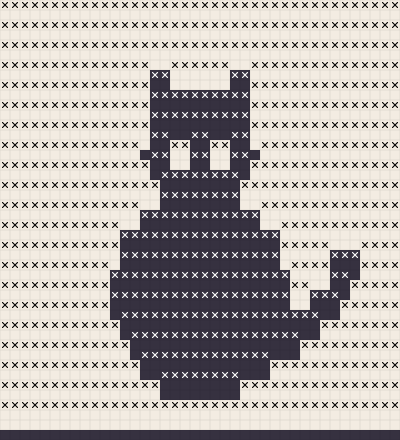
Your picture is processed in your browser and is not uploaded.
How mosaic crochet charts work
A mosaic chart looks like an ordinary two-color grid, but it is read with one extra rule: every row has one working color. Rows alternate between color A and color B. Most squares in a row show that row's color. A square shows the other color only when the stitch above it, from the next row, is dropped down over it.
That is why you can't just take any two-color picture and call it a mosaic pattern. The generator does the redrawing for you:
- It reduces your picture to two colors and the width you choose.
- It decides which color starts at row 1 so that as few squares as possible need changing.
- It checks every square against the rules below and outlines the ones that can't be worked in red.
- It suggests the smallest set of changes. Apply them all at once, or one by one.
The two rules of overlay mosaic
Both rules come straight from how the stitches are made:
- Two dropped stitches can't sit on top of each other. A mosaic double crochet lies in front of the stitch below it, so the next row can't reach that stitch's front loop. On the chart, two squares in the same column that both show the "other" color of their rows can't be next to each other.
- The first and last rows can't show the other color. A dropped stitch needs two rows below it, and nothing comes after the last row to drop over it.
When a run of squares breaks the first rule, changing every second square is enough. The generator always picks the fewest changes.
Overlay or inset?
| Overlay mosaic | Inset mosaic | |
|---|---|---|
| Look | Raised, textured front | Flat, smoother front |
| Back of the work | Rougher | Neater |
| Stitches | Single crochet in the back loop, dropped double crochet in front | Single crochet, chain spaces and dropped double crochet |
| Good for | Blankets, cushions | Bags, scarves where the back is seen |
Overlay and inset charts follow different rules, so a chart made for one can't simply be worked in the other style. This generator makes overlay charts.
Tips for a good mosaic design
- Start with strong shapes. Logos, letters and simple silhouettes convert far better than photographs.
- Use high contrast. Light and dark colors make the pattern readable from a distance.
- Keep the grid modest. 60 to 100 stitches wide is plenty for a cushion or a blanket panel.
- Add a border. Because you cut the yarn at each row end, a border or fringe hides the tails.
Frequently asked questions
What is mosaic crochet?
Mosaic crochet is a colorwork technique where you only use one color in each row, switching between two colors. The pattern is made by working some stitches down into the rows below, so they cover the row in between. You never carry two colors at once, which makes it easier than tapestry crochet.
What is the difference between overlay and inset mosaic crochet?
In overlay mosaic, you work single crochet through the back loop and drop double crochet stitches in front of the work into the rows below, which gives a textured, raised look. In inset mosaic, you use chain spaces and work the dropped stitches into them, so the fabric is flatter and the back looks neater. The two styles follow different chart rules. This generator makes overlay charts and writes overlay instructions.
Can any picture be made into mosaic crochet?
Not exactly. Because each row uses only one color, mosaic can't reproduce every shape a normal color chart can. Bold shapes, geometric designs, lettering and silhouettes work well; photos with soft shading don't. The generator reduces the picture to two colors, marks the squares that can't be worked and suggests the smallest change that makes the chart workable.
How do I read a mosaic crochet chart?
Start at the bottom and read every row from right to left. Odd rows are worked in color A and even rows in color B. A plain square is a single crochet in the back loop. A square marked × is a mosaic double crochet: a double crochet in the front loop of the stitch two rows below, which covers the square underneath it. The written instructions list the same stitches for every row.
Do I cut the yarn at the end of each row?
Yes, with this method. Every row is worked on the right side, so you join the new color at the start of the row and cut it at the end, leaving tails. The tails can become a fringe or be hidden under a border. Some designers work overlay mosaic back and forth instead; their charts are drawn differently, so follow the notes of the pattern you are using.
What yarn works best for mosaic crochet?
A smooth worsted or DK yarn in two strongly contrasting colors shows the pattern most clearly. Avoid fuzzy or very dark yarns, which hide the dropped stitches.